Endangered

I invite you to do a simple exercise. In your internet search bar, type the question: “What will be endangered by the year 2050?” Why 2050? Because it sounds like the title of a science fiction movie—a futuristic film, something distant and even unreal. Just for fun.
I did the search, and these headlines appeared: “Scientists set a date for human extinction: 2050.” “Koalas in danger: they could disappear by 2050.” “Five species that will no longer exist by 2050.” “Infographic: What will happen to religions and believers in 2050?” “Chocolate is endangered: it could disappear by 2050.” Thank God coffee isn’t on the endangered list for 2050, otherwise I’d already be asking the Lord to come soon!
These search results confront us with a troubling reality: the disappearance of species, alarming global changes, and uncertain projections for humanity. These headlines should concern us! Personally, it would alarm me if coffee were listed as endangered by 2050. The idea that coffee might disappear should cause panic. Instead of making movies about water scarcity, they should produce an entire futuristic series about the global tragedy of coffee shortages. In fact, just thinking about it makes me want to go buy enough coffee and store it in a secret warehouse. Of course, I wouldn’t forget plenty of coconut or almond milk—and my Italian coffee maker.
But beyond the physical or ecological—and even beyond the alarming “extinction” of coffee—there is something far more urgent that deserves our attention. It’s not only about what might disappear from the planet… but what might disappear from the human heart.
Is Kindness Becoming Endangered?
We live in a generation saturated with information. We can see what is happening anywhere in the world in real time. We watch, we comment, and we react—but we rarely stop to act with purpose. As a result, we risk becoming passive spectators rather than intentional shapers.
Within the context of the Living 24:15 ministry, we understand that God has not called us simply to observe society’s moral decline but to build homes that reflect His character. The transformation of a generation does not begin on social media—it begins in the hearts of parents and in the daily life of the home.
It is often said that there are three types of people: 1. Those who make things happen, 2. Those who watch things happen, 3. Those who have no idea what happened and ask what happened
In light of God’s Word, we could add a fourth group: those who, guided by the Spirit, choose to live intentionally to glorify God and shape the next generation.
The question is unavoidable: Are we raising children who merely observe… or children who live to do what is right before God? Now more than ever, we need families that not only react to culture but also influence it with a living faith.
When we look at our culture, it seems that kindness is being displaced by criticism, harshness, and indifference. Digital platforms have amplified voices that attack, ridicule, and divide. There is a growing tendency to criticize aggressively those who seek to do good. So-called “keyboard warriors” relentlessly attack others—even when those others are speaking or acting with kindness. This raises a serious question: Should we consider kindness an endangered species?
Scripture is clear: kindness is not optional or cultural—it is evidence of the fruit of the Spirit: “But the fruit of the Spirit is love, joy, peace, patience, kindness, goodness…” (Galatians 5:22–23).
Kindness does not simply come from good manners or social norms. True kindness flows from a heart transformed by Christ.
The Apostle Paul exhorted the church in Ephesus with these words: “Get rid of all bitterness, rage, anger, harsh words, slander, and all kinds of evil behavior. Instead, be kind to one another, tenderhearted, forgiving one another, just as God has forgiven you through Christ” (Ephesians 4:31–32). This command is not theoretical; it is deeply practical and begins at home.

A real example… one of many.
We know that the opposite of kindness—evil—also occurs, and it happens daily. It often dominates the headlines. On August 28, 2001, a 26-year-old woman climbed onto the edge of a 160-foot-high bridge in Seattle, Washington, intending to take her life. Some people passing by in vehicles—trucks and buses—frustrated by the traffic, shouted at her to jump: “Jump, you #@&%, jump.” A local radio station broadcast the incident live, with sarcastic commentary and even sound effects. The woman jumped from a height equivalent to a 16-story building. After briefly resurfacing in the river, she was taken to the hospital in critical condition. Psychologists did not draw firm conclusions from this incident, but they pointed to a dominant culture increasingly desensitized to violence and crisis.
Let’s define it.
What is kindness? The Collins Dictionary defines kindness as the quality of being gentle, caring, and helpful. It is also defined as the quality of being good. A natural inclination to do good. Good actions. Gentleness and mildness of temperament. Courtesy toward others as a form of politeness.
Do you remember the synonyms? Synonyms for kindness include compassion, gentleness, benevolence, attentiveness, mercy, consideration, and service. And what about antonyms? The opposite of kindness is evil and wickedness.
As we analyze these definitions, we see that kindness consists of two parts: first, the feelings of compassion and the motives of the heart; and second, the resulting behavior aimed at improving another person’s situation. Thus, kindness includes what is internal—hidden from others—and what is expressed—visible to others.
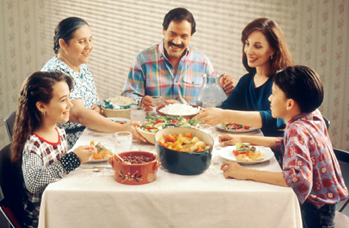
Kindness is expressed through words, actions, and nonverbal behavior. For example, a loving mother serving dinner to her family and asking about their day is a picture of kindness. She asks, “How was school? Did anything exciting happen at work?” Her actions are kind: she touches a shoulder, serves her daughter’s favorite meal, and kisses her cheek because it’s her birthday. She offers her husband more white rice and beans after a long, exhausting day at work. Her nonverbal gestures are gentle: she smiles, listens attentively, and uses a pleasant tone of voice. It is an ideal image that may even seem somewhat utopian. What do you think?
A responsibility that begins at home
At Living 24:15, we believe that character formation does not happen by accident, but through spiritual intentionality. Kindness is taught in the way we speak, in how we correct, in how we forgive, and in how we serve one another. Children learn more from what they see than from what they hear.
A home where grace, patience, and mutual service are practiced becomes fertile ground for kindness to flourish.
Returning to God’s design
Kindness is not in danger of extinction for those who remain in Christ. Jesus not only taught kindness—He modeled it perfectly. And our calling as parents is clear: to reflect Christ in our daily lives so that our children learn to do the same.
Rather than worrying about the future of the world in 2050, we should ask ourselves: What kind of hearts are we shaping today? What spiritual legacy are we leaving to our children?
Because when a family chooses to live 24:15, kindness does not disappear—it multiplies.
There are countless ways to show kindness to others. We have many opportunities each day. If the teaching of kindness dwells in our hearts and sinful influences or emotions do not overshadow this principle, then our behavior will be marked by goodness.
Do not limit yourself to merely observing; choose to live 24:15 intentionally, to glorify God and to shape the next generation.Because in the end, living 24:15 is not just a statement… it is a way of life.
Dad’s hugs!
Let’s meet in the neighborhood with a cup of coffee!
By: Dr. Rafael (Rafy) Gutierrez
Director/Founder: 24:15 Ministry
Copyright 2026.